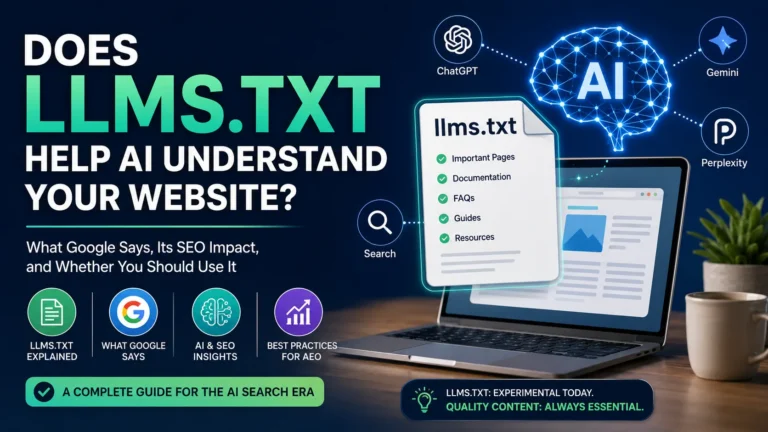
Artificial intelligence is changing how people find information online. With tools like ChatGPT, Google AI Overviews, Gemini, and Perplexity providing direct answers, businesses are looking for new ways to make their websites easier for AI systems to understand. One emerging topic is llms.txt, a proposed file that aims to guide large language models (LLMs) to important website content.
But does it actually improve AI understanding or search visibility? According to Google’s recent statements, the answer is not yet. While llms.txt is an interesting concept, there is currently no evidence that it improves rankings or helps AI models understand your website better.
In this guide, you’ll learn what llms.txt is, what Google says about it, and whether you should add it to your website.
Quick Answer
No, llms.txt does not currently help AI understand your website in a significant way. It is an experimental file that highlights important pages for AI systems, but Google has confirmed it is not a ranking factor. Creating helpful content, using structured data, and maintaining a well-organized website remain the most effective ways to optimize for AI-powered search.
Key Takeaways
- llms.txt is an experimental standard for AI systems.
- Google does not use llms.txt as a ranking signal.
- There is no proof that it improves AI understanding or visibility.
- Helpful content and structured data remain the foundation of AEO.
- You can experiment with llms.txt, but it should not replace proven SEO practices.
What is llms.txt?
llms.txt is a text file placed in the root directory of a website that points AI systems to important pages and resources.
It works similarly to robots.txt, but instead of controlling crawler access, it provides a curated list of content that website owners believe is most valuable.
An llms.txt file may include links to:
- Documentation
- Knowledge base articles
- FAQs
- Product pages
- API references
- Technical guides
The idea is to make it easier for AI systems to discover high-value information. However, llms.txt is still an emerging proposal and has not been adopted as an official web standard.
What Does Google Say About llms.txt?
Google has made it clear that llms.txt is not a Google Search ranking factor.
In a recent Search Engine Journal article discussing Google’s response to questions about llms.txt, the company explained that adding the file does not improve search rankings or indexing. Instead, Google continues to recommend focusing on high-quality content, technical SEO, and a positive user experience.
This reinforces an important point: there are no shortcuts to better AI visibility. Websites that publish original, well-structured, and trustworthy content are more likely to perform well than those relying on experimental files alone.
What Did John Mueller Say About llms.txt?
Google Search Advocate John Mueller also addressed misconceptions surrounding llms.txt.
Another Search Engine Journal report highlighted Mueller’s explanation that llms.txt cannot help large language models differentiate one website from another. AI systems rely on many signals—such as content quality, context, internal linking, and website authority—rather than a single text file.
This means implementing llms.txt alone will not make your website more understandable to AI.
Should You Add llms.txt to Your Website?
The answer depends on your goals.
| Website Type | Recommendation |
| Blog | Optional |
| Local Business | Low Priority |
| eCommerce Store | Optional |
| SaaS Platform | Worth Testing |
| Documentation Website | Recommended to Experiment |
For websites with extensive documentation or knowledge bases, testing llms.txt may be worthwhile. However, for most businesses, investing in content quality and technical SEO will deliver greater long-term value.
What Actually Helps AI Understand Your Website?
Rather than relying on an experimental file like llms.txt, AI systems use multiple signals to understand and evaluate your website. If you want to improve your visibility in AI-powered search, focus on proven SEO and AEO best practices.
Prioritize Helpful, User-Focused Content
Create original content that answers real user questions. Articles should include:
- Clear explanations
- Practical examples
- Step-by-step guidance
- Comparison tables
- Frequently asked questions
Content that directly solves a user’s problem is more likely to be referenced by AI tools.
Organize Your Website Clearly
A logical website structure helps both search engines and AI systems understand relationships between your pages. Use:
- Descriptive headings (H1, H2, H3)
- Short paragraphs
- Internal links between related topics
- Easy-to-follow navigation
Use Structured Data
Schema markup provides additional context about your content. Adding Article, FAQ, Organization, and Breadcrumb schema can help search engines interpret your pages more effectively.
Build Topical Authority
Instead of publishing unrelated articles, create content clusters around your core topics. This demonstrates expertise and helps AI understand what your website specializes in.
AI SEO Checklist
Use this checklist to prepare your website for AI-powered search experiences.
| Best Practice | Recommended |
| Publish original, helpful content | ✅ |
| Answer questions directly | ✅ |
| Use descriptive headings | ✅ |
| Add structured data (Schema) | ✅ |
| Improve internal linking | ✅ |
| Keep content updated | ✅ |
| Optimize page speed | ✅ |
| Test llms.txt (Optional) | ✅ |
Should You Rely on llms.txt?
No. At present, llms.txt should be viewed as an optional experiment rather than an essential optimization technique.
Although the concept has generated interest within the SEO community, Google’s guidance suggests that businesses should continue focusing on strategies with proven results.
If future AI platforms officially adopt llms.txt, its importance may increase. Until then, creating high-quality, well-structured content remains the best investment for long-term organic visibility.
Final Verdict
So, does llms.txt actually help AI understand your website?
Not significantly—at least not today.
Google has confirmed that llms.txt is not a ranking factor, and comments from John Mueller indicate that it does not help large language models distinguish one website from another. While experimenting with llms.txt won’t hurt your website, it shouldn’t replace proven optimization strategies.
Instead, focus on creating content that is informative, trustworthy, and easy to understand. Combine that with structured data, strong internal linking, and a solid technical foundation to improve your chances of appearing in both traditional search results and AI-generated answers.
At Vivid Digisolution, we believe businesses should embrace emerging AI technologies while continuing to invest in the SEO fundamentals that consistently deliver measurable results. A balanced approach ensures your website is prepared for today’s search engines and tomorrow’s AI-powered experiences.
Frequently Asked Questions
1. Does llms.txt improve Google rankings?
No. Google has confirmed that llms.txt is not a ranking factor.
2. Is llms.txt required for AI search?
No. AI systems can understand websites using publicly available content, structured data, and other web signals.
3. Should every website implement llms.txt?
Not necessarily. It’s optional and may be more useful for websites with extensive documentation or knowledge bases.
4. Is llms.txt better than schema markup?
No. Schema markup is an established method for helping search engines understand website content, while llms.txt is still experimental.
5. What is the best way to optimize for AI search?
Focus on publishing helpful content, answering user questions clearly, using structured data, improving internal linking, and maintaining a technically sound website.