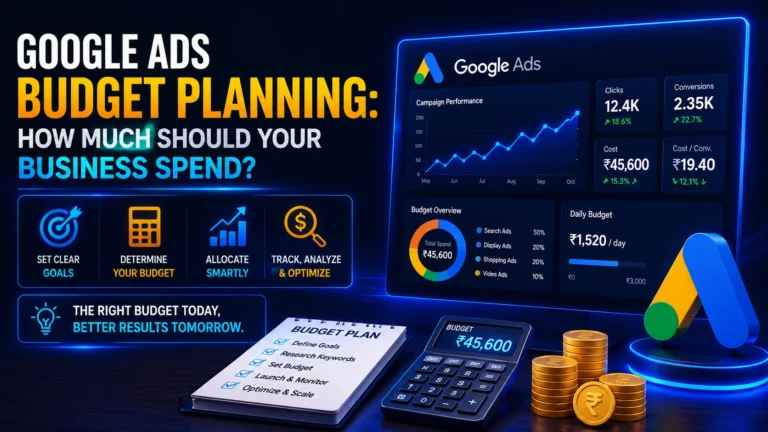
There is no one-size-fits-all Google Ads budget. The right budget depends on your business goals, industry competition, target audience, and campaign objectives. Most small businesses start with a manageable monthly budget and gradually increase spending as campaigns deliver consistent leads and a positive return on investment (ROI).
Why Google Ads Budget Planning Matters
Setting the right Google Ads budget is essential for running profitable advertising campaigns. Spending too little may limit your visibility, while spending too much without a strategy can increase costs without delivering meaningful results.
A well-planned budget helps you:
- Reach the right audience
- Control advertising costs
- Generate quality leads
- Improve campaign performance
- Maximize your return on investment (ROI)
Instead of asking, “How much should I spend?”, ask “How much should I invest to achieve my business goals?” Your budget should support your objectives while remaining sustainable over time.
How Google Ads Budgeting Works
Google Ads uses a daily budget system, giving businesses flexibility to control their advertising spend.
Daily Budget
A daily budget is the average amount you’re willing to spend each day on a campaign. Google may spend slightly more or less on certain days depending on traffic, but your monthly spending won’t exceed your monthly budget limit.
Monthly Budget
Your estimated monthly budget is calculated by multiplying your daily budget by approximately 30.4 days.
For example:
| Daily Budget | Estimated Monthly Budget |
| ₹500 | ₹15,200 |
| ₹1,000 | ₹30,400 |
| ₹2,000 | ₹60,800 |
| ₹5,000 | ₹1,52,000 |
This flexibility allows businesses to start small and increase spending as campaigns prove successful.
Factors That Affect Your Google Ads Budget
No two businesses have the same advertising costs. Several factors influence how much you should invest.
1. Industry Competition
Highly competitive industries such as legal services, insurance, finance, and healthcare often have higher cost-per-click (CPC) than less competitive niches.
2. Campaign Goals
Your objective directly impacts your budget.
For example:
- Brand awareness campaigns may require a broader reach.
- Lead generation campaigns focus on qualified clicks.
- Sales campaigns often need higher budgets to remain competitive.
3. Target Location
Advertising in large metropolitan areas usually costs more than targeting smaller cities or regional markets because of increased competition.
4. Keyword Competition
Highly searched keywords generally attract more advertisers, increasing CPC. Choosing a mix of high-intent and long-tail keywords can help control costs while improving conversion rates.
5. Quality Score
Google rewards relevant ads and high-quality landing pages with better Quality Scores, which can lower your cost per click and improve ad placement.
How Much Should Different Businesses Spend?
The ideal budget varies depending on business size, goals, and competition. The figures below are general examples to help with planning.
| Business Type | Suggested Monthly Budget |
| Local Business | ₹15,000–₹40,000 |
| Small Business | ₹40,000–₹1,00,000 |
| Growing Business | ₹1,00,000–₹3,00,000 |
| Large Business | ₹3,00,000+ |
These are starting points. The right budget should be based on your target cost per lead, conversion rate, and expected return on investment.
How to Set a Realistic Google Ads Budget
Instead of guessing a number, use a simple planning process:
- Define your marketing goal.
- Estimate how many leads or sales you need.
- Research your average cost per click.
- Calculate your expected conversion rate.
- Set a monthly budget based on your desired results.
- Review campaign performance regularly and adjust as needed.
Starting with a manageable budget allows you to gather performance data before increasing your investment.
Tips to Maximize Your Google Ads Budget
Having a larger budget doesn’t always guarantee better results. The key is to spend your budget wisely and optimize your campaigns regularly.
Focus on High-Intent Keywords
Target keywords that indicate users are ready to take action, such as purchasing a product or requesting a service. These keywords often generate higher-quality leads and better conversion rates.
Use Negative Keywords
Negative keywords prevent your ads from appearing for irrelevant searches. This helps reduce wasted clicks and ensures your budget is spent on potential customers.
Improve Your Landing Pages
An optimized landing page can increase your conversion rate without increasing your advertising budget.
Make sure your landing page:
- Loads quickly
- Is mobile-friendly
- Matches your ad message
- Includes a clear call-to-action
- Builds trust with testimonials or reviews
Monitor Campaign Performance
Review your campaign data regularly to identify:
- High-performing keywords
- Low-performing ads
- Conversion rates
- Cost per conversion
Use these insights to improve performance and reduce unnecessary spending.
Test and Optimize
Google Ads is an ongoing process. Test different headlines, descriptions, bidding strategies, and audiences to discover what works best for your business.
Common Google Ads Budget Mistakes
Avoiding common mistakes can help you make the most of your advertising investment.
| Mistake | Better Approach |
| Starting with an unrealistic budget | Set a budget based on your goals and expected ROI |
| Ignoring conversion tracking | Measure leads, sales, and other valuable actions |
| Targeting broad keywords only | Combine high-intent and long-tail keywords |
| Not reviewing campaign performance | Analyze and optimize campaigns regularly |
| Increasing budget without data | Scale spending only after consistent results |
By avoiding these mistakes, you can improve campaign efficiency and achieve better long-term results.
Signs It’s Time to Increase Your Budget
You don’t always need to increase your budget immediately. Consider scaling your investment when:
- Your campaigns consistently generate profitable leads or sales.
- You’re losing impressions due to budget limitations.
- Your conversion rate remains strong.
- Your return on investment is positive.
- You’re planning to expand into new markets or promote seasonal offers.
Increasing your budget should be a strategic decision supported by campaign performance data.
Final Thoughts
Google Ads budget planning is about balancing your business goals with smart spending. Starting with a realistic budget, tracking key performance metrics, and continuously optimizing your campaigns can help you generate better results without overspending. As your campaigns become more profitable, you can confidently scale your budget to support long-term business growth.
If you’d like to gain a deeper understanding of campaign setup, bidding strategies, optimization techniques, and best practices, learn everything about Google Ads campaigns. For businesses seeking expert support with campaign planning, optimization, and measurable advertising results, Vivid Digisolution provides tailored Google Ads strategies designed to maximize ROI and support sustainable growth.
Frequently Asked Questions
1. What is a good starting Google Ads budget for a small business?
A small business can start with a monthly budget of ₹15,000 to ₹40,000, depending on its industry, competition, and marketing goals. Start with a manageable budget, monitor performance, and increase spending once you achieve consistent results.
2. Can I change my Google Ads budget anytime?
Yes. Google Ads allows you to increase or decrease your daily budget whenever needed. This flexibility helps businesses respond to seasonal demand, campaign performance, or changing marketing objectives.
3. How can I reduce my Google Ads costs?
You can lower advertising costs by targeting high-intent keywords, improving your Quality Score, using negative keywords, optimizing landing pages, and regularly reviewing campaign performance to eliminate wasted spend.
4. Does a higher budget guarantee better results?
No. A larger budget increases your potential reach, but campaign success depends on factors such as targeting, ad quality, keyword selection, landing page experience, and ongoing optimization. A well-managed campaign with a moderate budget often outperforms a poorly optimized campaign with a larger budget.