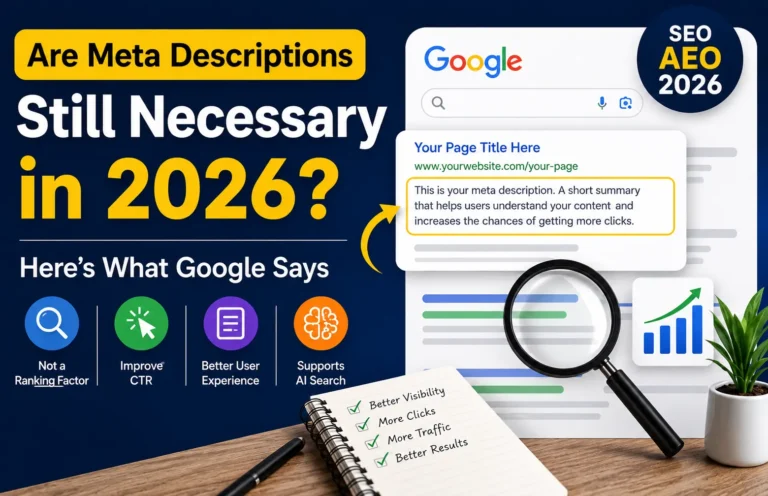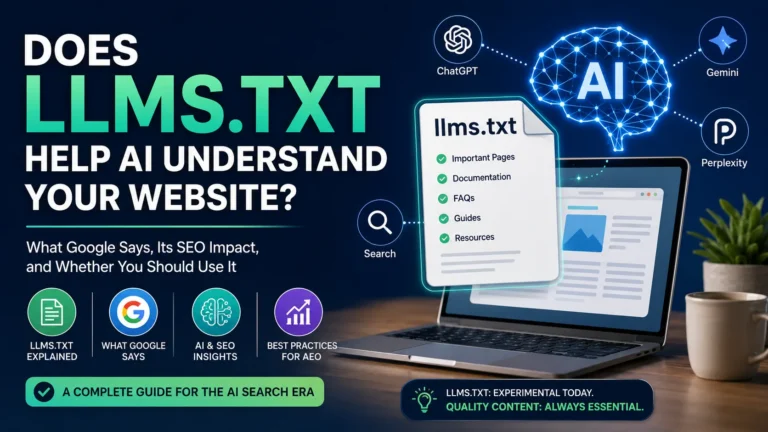
Yes, meta descriptions are still necessary in 2026. Although Google has confirmed that they are not a direct ranking factor, they remain valuable because they improve click-through rates (CTR), help users understand what a page is about, and may be used as the search snippet when they accurately summarize the content. They also support modern Answer Engine Optimization (AEO) by giving AI systems and users a concise overview of your page.
At Vivid DigiSolution, we’ve found that websites combining high-quality content with compelling meta descriptions generally achieve better engagement than pages that ignore them altogether.
Key Takeaways
- Meta descriptions are not a Google ranking factor.
- They can significantly improve organic click-through rates.
- Google may rewrite your meta description depending on the search query.
- Every important page should have a unique meta description.
- Meta descriptions support AEO by clearly summarizing page content.
- Writing for users is more important than stuffing keywords.
What Is a Meta Description?
A meta description is a summary of a webpage that appears below the page title in search results.
Its purpose isn’t to help a page rank higher directly. Instead, it helps users decide whether your page is the best answer to their question.
For example:
Title: Digital Marketing Agency in Vadodara
Meta Description: Grow your business with expert SEO, PPC, website development, and social media marketing services from Vivid DigiSolution.
Think of it as a short advertisement for your page. A clear and relevant description can encourage users to click your result instead of someone else’s.
What Does Google Say About Meta Descriptions?
Google has consistently explained that meta descriptions are not used as a ranking signal. However, Google still recommends writing unique descriptions because they help users understand what a page offers.
Google may also choose to display your meta description in search results if it accurately matches the user’s search intent.
A recent analysis highlighted by Search Engine Journal reinforced this point, explaining that while meta descriptions don’t directly improve rankings, Google still considers them worthwhile because they help users and can improve click-through rates when they accurately summarize the page.
The takeaway is simple:
Meta descriptions won’t move your page to Position #1, but they can persuade more users to click your result once you’re visible in search.
Are Meta Descriptions Still Important for SEO in 2026?
Yes.
Modern SEO isn’t only about rankings anymore. Success depends on attracting qualified traffic and delivering the best possible user experience.
Meta descriptions contribute to both.
They Improve Click-Through Rate
When users see several similar search results, the description often influences which one they choose.
A compelling description should:
- Answer the searcher’s question
- Explain the benefit
- Build trust
- Encourage action
Higher click-through rates can lead to more qualified visitors and better overall search performance.
They Improve User Experience
Users want to know what they’ll find before clicking.
A clear description sets the right expectations, reducing frustration and increasing the likelihood that visitors stay on your page.
They Support AI-Powered Search
Answer engines such as Google AI Overviews, ChatGPT, Gemini, and Perplexity rely on multiple signals to understand web content.
While meta descriptions aren’t the primary source of information, they provide a concise summary that reinforces your page’s topic and intent.
For AEO, every layer of clarity matters.
Does Google Rewrite Meta Descriptions?
Yes—and that’s completely normal.
Google rewrites snippets when another section of your page better matches a user’s search query.
Google may replace your description if:
- It doesn’t answer the search query.
- It’s duplicated across multiple pages.
- It’s too short or too long.
- It contains keyword stuffing.
- Another paragraph provides a better summary.
This doesn’t mean your meta description is poor.
Instead, Google is trying to display the snippet most relevant to that specific search.
Should Every Page Have a Meta Description?
Yes.
Although Google may generate its own snippet, writing your own description gives you control over how your page is presented.
Priority pages include:
- Homepage
- Service pages
- Product pages
- Category pages
- Blog posts
- Landing pages
- Contact page
Every description should accurately reflect the page’s content.
How to Write Meta Descriptions That Work in 2026
Write for Humans First
Don’t write for search engines.
Instead, answer this question:
Why should someone click this page?
Natural, benefit-focused descriptions outperform keyword-heavy text.
Include Your Primary Keyword Naturally
Mention your primary keyword once if it fits naturally.
Avoid repeating it multiple times.
Keep It Concise
Aim for approximately 150–160 characters.
Google doesn’t enforce a strict limit, but shorter descriptions are easier to display across devices.
Highlight the Benefit
Tell users what they’ll gain.
Instead of saying:
“SEO services available.”
Say:
“Learn proven SEO strategies that increase organic traffic and improve online visibility.”
Benefits attract clicks.
Add a Clear Call to Action
Simple phrases like these often improve engagement:
- Learn more
- Discover how
- Read the guide
- Find out today
- Get started
Meta Description Best Practices at a Glance
| Best Practice | Recommended |
| Unique for every page | ✅ |
| Primary keyword included naturally | ✅ |
| Around 150–160 characters | ✅ |
| Written for users first | ✅ |
| Includes a clear benefit | ✅ |
| Avoids keyword stuffing | ✅ |
| Matches page content | ✅ |
Common Mistakes to Avoid
Many websites still make these errors:
- Using the same description on every page
- Stuffing multiple keywords
- Writing vague summaries
- Creating misleading clickbait
- Leaving important pages without descriptions
- Failing to match user intent
Small improvements here can make a noticeable difference in organic performance.
Expert Insight from Vivid DigiSolution
At Vivid DigiSolution, we’ve observed that businesses often spend months improving rankings but overlook the search snippet users actually see.
A compelling meta description won’t guarantee higher rankings, but it can increase the likelihood that users choose your website over competing results. Think of it as your first opportunity to make a positive impression in search.
People Also Ask
Can I leave the meta description blank?
Yes, but Google will generate its own snippet. Writing your own gives you more control over how your page appears.
Are meta descriptions a Google ranking factor?
No. Google has confirmed that meta descriptions are not a direct ranking factor.
Why does Google ignore my meta description?
Google may choose another section of your content if it better matches the user’s search intent.
How many keywords should a meta description contain?
Usually, one primary keyword is enough. Focus on readability rather than keyword density.
Do meta descriptions help AI search?
Indirectly, yes. They provide a concise summary that supports Answer Engine Optimization alongside structured content, headings, and schema markup.
Are duplicate meta descriptions bad?
Yes. Duplicate descriptions reduce relevance and make it harder for search engines to distinguish between pages.
Final Thoughts
So, are meta descriptions still necessary in 2026?
The answer is yes.
Although Google doesn’t use them as a ranking factor, they remain an essential part of a successful SEO and AEO strategy. They help users understand your content, encourage higher click-through rates, and provide another layer of context that supports both traditional search engines and AI-powered search experiences.
As search continues to evolve, success will come from creating helpful, user-focused content rather than chasing individual ranking signals. A well-written meta description is one small but important element of that broader strategy.
At Vivid DigiSolution, we recommend treating every meta description as a chance to answer a user’s question, highlight your page’s value, and encourage meaningful engagement. Combined with quality content, structured data, fast-loading pages, and strong on-page SEO, thoughtful meta descriptions continue to contribute to better search visibility in 2026 and beyond.