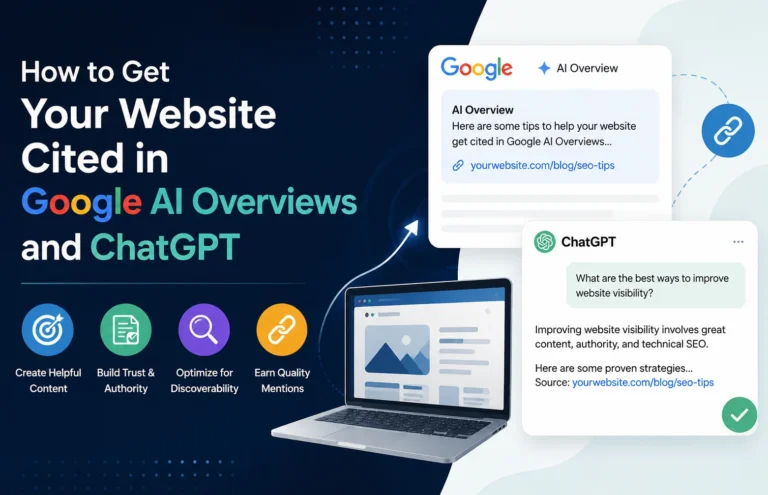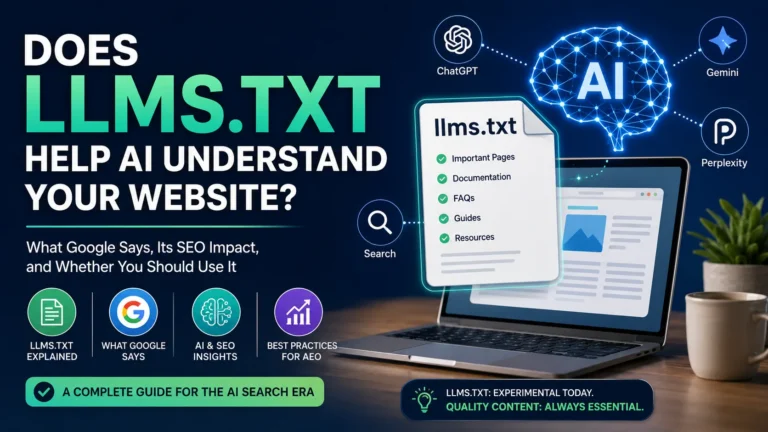
Getting your website cited in Google AI Overviews and ChatGPT starts with creating original, trustworthy, and well-structured content that directly answers user questions. AI search platforms are more likely to reference websites that demonstrate expertise, cover topics in depth, use clear headings, and provide valuable information supported by credible sources.
Key Takeaways
- Answer users’ questions clearly and early in your content.
- Build topical authority by publishing content around your niche.
- Write for people first, then optimize for AI search.
- Use structured headings, tables, and FAQs to improve readability.
- Keep content updated with accurate information and trusted sources.
- Focus on EEAT (Experience, Expertise, Authoritativeness, and Trustworthiness).
Introduction
Search is changing faster than ever. Instead of scrolling through multiple search results, users are increasingly getting direct answers from Google AI Overviews, ChatGPT, Gemini, and other AI-powered search tools. These platforms summarize information from trusted websites, making it more important than ever for businesses to become a reliable source rather than simply ranking on the first page of Google.
Being cited by AI doesn’t happen by chance. It requires high-quality content, strong topical authority, and a website that search engines can easily understand. Businesses that adapt to this shift can gain greater visibility, build trust, and attract highly relevant visitors.
Why Is It Important to Get Cited in Google AI Overviews and ChatGPT?
Getting cited by AI platforms increases your brand’s visibility, authority, and chances of attracting qualified traffic.
Unlike traditional search results, AI-generated answers often highlight only a few trusted sources. If your content is selected, your website can become the reference that users rely on before making decisions.
Some of the biggest benefits include:
- Increased brand credibility
- Higher visibility in AI-generated answers
- Better-qualified traffic
- Stronger topical authority
- Long-term SEO growth
- Greater trust among potential customers
Although AI Overviews may reduce clicks for some informational searches, research suggests that the lost clicks are not necessarily from lower-quality visitors. Engagement signals such as bounce rate, time spent, and return-to-search behavior showed no major differences.
How Do Google AI Overviews Choose Websites?
Google AI Overviews prioritize content that is helpful, accurate, trustworthy, and directly answers user questions.
While Google hasn’t revealed its complete selection process, several patterns have become clear through official guidance and industry research.
AI systems generally prefer websites that:
- Provide clear answers immediately
- Cover topics in depth
- Demonstrate real expertise
- Are technically optimized
- Have strong topical authority
- Use logical heading structures
- Publish original insights instead of copied content
Rather than focusing only on keyword placement, AI evaluates whether your page genuinely helps users understand the topic.
What Type of Content Is More Likely to Be Used by AI Search Tools?
ChatGPT is more likely to reference content that is comprehensive, factual, and easy to understand.
AI models perform better when content is organized logically. Instead of long introductions, begin by answering the main question and then explaining the details.
For example:
Question: How can I improve my chances of being cited by AI?
Answer: Create trustworthy content that answers questions clearly, demonstrates expertise, and covers the topic thoroughly.
After the direct answer, expand on the explanation with examples, best practices, and supporting information.
This format makes your content easier for both readers and AI systems to interpret.
Traditional SEO vs AEO: What’s the Difference?
Both Search Engine Optimization (SEO) and Answer Engine Optimization (AEO) are important, but they serve different purposes.
| Traditional SEO | AEO |
| Focuses on rankings | Focuses on direct answers |
| Targets keywords | Targets user questions |
| Optimizes for search engines | Optimizes for AI search engines |
| Measures clicks | Measures citations and visibility |
| Encourages page visits | Helps AI understand your content |
The best strategy today is to combine both approaches rather than choosing one over the other.
How Can You Build Topical Authority for AI Search?
Publishing consistent, high-quality content around one subject helps AI understand your expertise.
Instead of writing about unrelated topics, focus on creating content clusters within your industry.
For a digital marketing website, this could include topics such as:
- Technical SEO
- Local SEO
- AI SEO
- Content marketing
- Google Search Console
- Schema markup
- Core Web Vitals
- Link building
- Website optimization
These interconnected articles help search engines recognize your website as a trusted resource.
If you’re planning a long-term strategy, investing in professional AI SEO services can help build topical authority while improving your visibility across both search engines and AI-powered platforms.
What Do Recent Studies Say About AI Search?
Recent research on Google AI Overviews and search click behavior shows that AI-generated answers are changing how users interact with search results.
Key findings include:
- AI Overviews can reduce organic clicks because users may find answers directly on the search page.
- Lost clicks from AI Overviews are not necessarily from low-quality visitors.
- The study found no major difference in engagement signals like bounce rate, time spent, or return-to-search behavior.
- Businesses should focus on creating trustworthy content that AI platforms can confidently reference.
These findings show that success in AI search is not only about clicks but also about improving visibility, authority, and brand presence.
How Should You Measure Success in AI Search?
AI search success should be measured beyond traditional clicks and rankings.
Google has explained that AI search impressions are counted similarly to other search features, which helps website owners understand their visibility even when users interact with AI-generated answers.
Important points include:
- AI visibility can increase brand awareness even without direct clicks.
- Search impressions help measure how often your content appears in AI-powered results.
- Businesses should track visibility, engagement, and authority along with website traffic.
Understanding these metrics helps businesses create better strategies for Google AI Overviews and other AI search platforms.
How Can You Improve EEAT for AI Citations?
Strong EEAT signals help AI platforms determine whether your content is trustworthy enough to reference.
EEAT stands for Experience, Expertise, Authority, and Trustworthiness. While EEAT is not a direct ranking factor, Google uses these quality signals to evaluate whether content demonstrates experience, expertise, authority, and trustworthiness.
You can strengthen your EEAT by:
- Sharing original insights and real-world experience.
- Publishing accurate and up-to-date information.
- Adding an author bio with relevant expertise.
- Citing reliable industry sources when needed.
- Displaying clear contact information and business details.
- Keeping older articles updated with the latest information.
The more trustworthy your website appears, the more likely it is to become a reliable source for AI search.
Does Schema Markup Help AI Understand Your Website?
Yes. Schema markup helps search engines understand your content, although it doesn’t guarantee AI citations.
Structured data gives search engines additional context about your pages. This makes it easier to identify your content type, author, organization, FAQs, and other important details.
Useful schema types include:
- Article Schema
- FAQ Schema
- Organization Schema
- Breadcrumb Schema
- WebPage Schema
- Author Schema
Think of a schema as a roadmap that helps search engines interpret your content more accurately.
Why Is Technical SEO Still Important for AI Search?
AI platforms rely on search engine data, so technical SEO remains essential.
Even the best content can struggle to gain visibility if search engines can’t crawl or understand your website properly.
Make sure your website has:
- Fast-loading pages
- Mobile-friendly design
- HTTPS security
- Clean URL structure
- Optimized Core Web Vitals
- XML sitemap
- Proper internal linking
- No broken pages or crawl errors
A technically healthy website gives search engines and AI systems the confidence to index and reference your content.
AI Citation Optimization Checklist
Use this checklist before publishing any article:
✅ Answer the main question within the first 60 words.
✅ Write for users before search engines.
✅ Organize content with clear question-based H2 and H3 headings.
✅ Add comparison tables where helpful.
✅ Include examples and original insights.
✅ Build topical authority through related articles.
✅ Use relevant schema markup.
✅ Improve page speed and mobile usability.
✅ Update content regularly.
✅ Add meaningful internal links and trusted external references.
Following these steps consistently can significantly improve your chances of being referenced by AI-powered search platforms.
Common Mistakes That Prevent AI Citations
Even well-written content can miss AI citation opportunities if it makes these common mistakes.
- Writing only for keywords
Keyword stuffing makes content difficult to read and provides little value to users. Focus on answering questions naturally instead.
- Publishing thin content
Short articles that only scratch the surface rarely become trusted AI sources. Cover topics comprehensively.
- Ignoring user intent
Understand why someone is searching before writing. Every section should help solve a specific problem.
- Not updating old content
Outdated information reduces credibility. Refresh important pages regularly with current examples and insights.
- Weak internal linking
Connecting related pages helps search engines understand your expertise and improves the user experience.
Frequently Asked Questions
1. Can any website appear in Google AI Overviews?
Yes. Any website with helpful, original, and trustworthy content has the potential to be cited. Google does not limit AI Overviews to large brands, but your content should demonstrate expertise and satisfy user intent.
2. Does ranking first on Google guarantee AI citations?
No. High rankings can improve visibility, but AI systems prioritize content quality, clarity, topical authority, and usefulness over rankings alone.
3. How often should I update content for AI search?
Review important pages every three to six months or whenever there are significant industry updates. Fresh and accurate content is more likely to remain relevant for AI-generated answers.
4. Is schema markup required for AI Overviews?
Schema markup isn’t mandatory, but it helps search engines understand your content more effectively. Combined with high-quality content, it can improve your chances of being referenced.
5. What’s the best way to get cited by ChatGPT and Google AI Overviews?
Create content that answers questions directly, demonstrates real expertise, provides unique value, and is organized in a way that’s easy for both users and AI systems to understand.
Conclusion
AI-powered search is changing how people discover information online. Instead of focusing only on rankings, businesses should aim to become trusted sources that AI platforms confidently reference.
The best way to get your website cited in Google AI Overviews and ChatGPT is to publish original, experience-driven content that answers user questions clearly, demonstrates expertise, and is supported by strong technical SEO. Combining traditional SEO with Answer Engine Optimization (AEO) ensures your content remains visible as search continues to evolve.
At Vivid Digisolution, we believe the future of digital marketing lies in creating content that serves both people and AI. By building topical authority, improving EEAT, and publishing genuinely helpful resources, your website can increase its chances of being cited, trusted, and discovered across the next generation of search experiences.