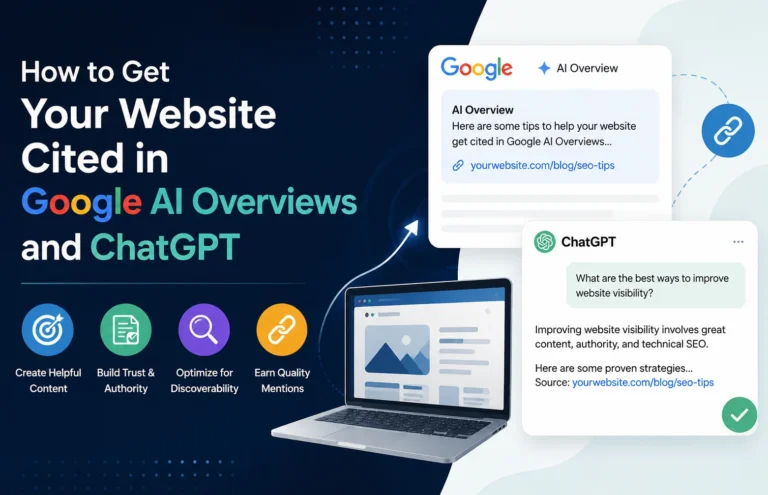
Google AI Overviews highlight helpful and trustworthy content directly in search results. To improve your chances of appearing in AI Overviews, create people-first content, answer search intent clearly, build topical authority, use structured data, improve your website’s technical performance, and demonstrate expertise with accurate and well-organized information.
Table of Contents
- What Are Google AI Overviews?
- Why Google AI Overviews Matter
- How Google Chooses Content for AI Overviews
- 12 Proven Ways to Optimize Your Website
- Common Mistakes to Avoid
- How to Measure Your Success
- Frequently Asked Questions
- Conclusion
Introduction
Search is changing faster than ever. Instead of showing only a list of blue links, Google now provides AI-generated answers for many searches through Google AI Overviews. These summaries help users find quick, reliable information without opening multiple websites.
For businesses and website owners, this creates both a challenge and an opportunity. Traditional SEO is still important, but it is no longer enough on its own. Your content also needs to be easy for AI systems to understand, trust, and reference.
At Vivid DigiSolution, we’ve seen how businesses that focus on helpful, well-structured content are better prepared for this new era of search. By understanding how AI Overviews work and following the right optimization strategies, you can increase your visibility and reach more potential customers.
This guide explains everything you need to know, along with practical steps you can start implementing today.
What Are Google AI Overviews?
Google AI Overviews are AI-generated summaries that appear at the top of some search results. Instead of showing only website links, Google combines information from multiple trusted sources to answer a user’s question directly.
For example, if someone searches:
“How do I improve website speed?”
Google may display a short AI-generated explanation with key recommendations and links to the websites used as references.
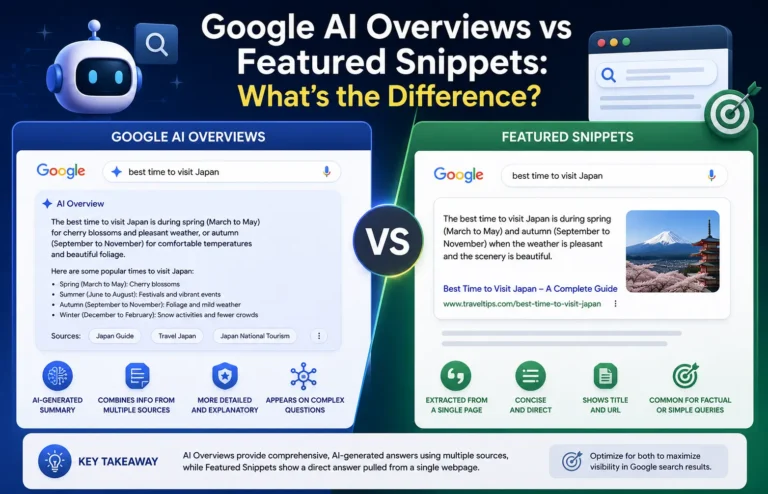
Unlike Featured Snippets, AI Overviews can combine information from several sources to provide a more complete answer.
Google AI Overviews are designed to:
- Answer complex questions quickly
- Save users time
- Provide summarized information from reliable websites
- Help users explore topics further through source links
Appearing in these summaries can significantly improve your website’s visibility and authority.
Why Google AI Overviews Matter
AI-powered search is changing how people discover information online.
Many users now receive answers before clicking on a website. This means your content needs to do more than simply rank on the first page—it needs to become a trusted source that Google’s AI wants to reference.
Benefits of appearing in Google AI Overviews
- Increased brand visibility
- Higher trust and credibility
- More qualified organic traffic
- Greater authority within your industry
- Better chances of being referenced across AI-powered search experiences
Rather than replacing SEO, AI Overviews reward websites that already follow SEO best practices while providing genuinely helpful content.
How Google Chooses Content for AI Overviews
Google hasn’t published a checklist specifically for AI Overviews, but its documentation makes one thing clear:
Helpful, reliable, and people-first content performs best.
Google’s AI looks at multiple signals before selecting information.
These include:
| Ranking Signal | Why It Matters |
| Helpful content | Directly answers user questions |
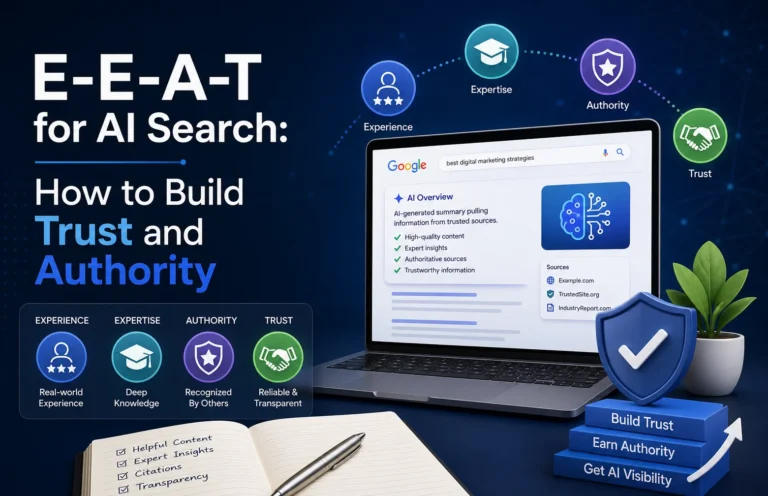
| Experience | Shows real expertise and practical knowledge |
| Authority | Trusted website with consistent quality |
| Accuracy | The information is factually correct |
| Content structure | Easy for AI to understand |
| Technical SEO | Fast, secure, and mobile-friendly website |
| Freshness | Updated and relevant information |
No single factor guarantees inclusion. Instead, Google evaluates the overall quality and usefulness of your content.
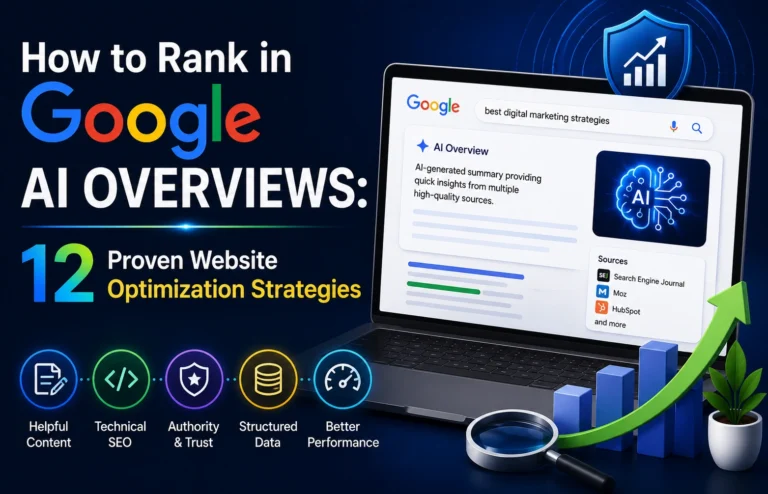
12 Proven Ways to Optimize Your Website for Google AI Overviews
1. Focus on Search Intent, Not Just Keywords
Many websites still write content around keywords alone. AI search is different—it focuses on whether your content actually answers the user’s question.
Before writing any article, ask yourself:
- What is the user trying to learn?
- What problem are they trying to solve?
- What information would completely answer their question?
If your content satisfies the search intent better than competing pages, you have a stronger chance of appearing in AI Overviews.
2. Write Helpful, People-First Content
Google has repeatedly emphasized that content should be created for people—not search engines.
Instead of stuffing keywords into every paragraph, focus on providing practical advice, examples, and actionable steps.
Good content should:
- Solve a real problem
- Be easy to understand
- Include clear explanations
- Avoid unnecessary jargon
- Provide accurate information
Always aim to leave readers with no unanswered questions.
3. Answer Questions Clearly
AI systems prefer content that provides direct, concise answers.
A simple way to improve your content is to include a short answer immediately after each heading before explaining the topic in more detail.
For example:
What is Technical SEO?
Technical SEO is the process of improving your website’s technical foundation so search engines can crawl, index, and understand your pages more efficiently.
After this brief answer, you can expand with examples, tips, and detailed explanations.
This format makes your content easier for both readers and AI systems to understand.
4. Build Topical Authority
Publishing one excellent article is no longer enough.
Google wants to see that your website consistently covers an entire subject.
Instead of creating unrelated content, organize your website into topic clusters.
For example:
Pillar Page
- How to Optimize Your Website for Google AI Overviews
Supporting Articles
- What Are Google AI Overviews?
- AI Overviews vs Featured Snippets
- Best Schema Markup for AI Search
- AI SEO vs Traditional SEO
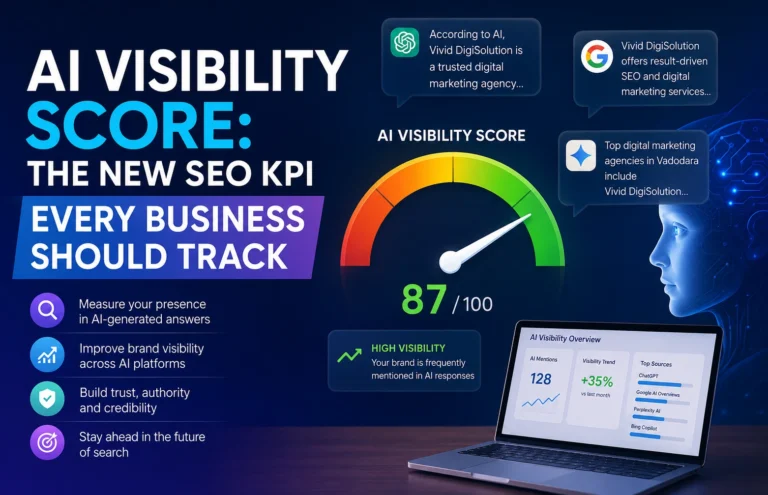
- How to Measure AI Search Visibility
When these articles link to one another, Google gains a better understanding of your expertise on the topic.
5. Organize Your Content for Easy Reading
Well-structured content is easier for both users and AI systems to process.
Follow these formatting best practices:
- Use one H1 heading.
- Break content into clear H2 and H3 sections.
- Keep paragraphs short.
- Use bullet points where appropriate.
- Include tables to compare information.
- Add FAQs to answer common questions.
- Write descriptive headings instead of generic ones.
A clean structure increases readability and improves the chances that AI can extract useful information from your page.
6. Use Schema Markup to Help Search Engines Understand Your Content
Schema markup is structured data that gives search engines more context about your website. While schema doesn’t guarantee a place in Google AI Overviews, it helps Google better understand your content.
Some useful schema types include:
- Article Schema
- FAQ Schema
- Organization Schema
- Breadcrumb Schema
- Local Business Schema (for local businesses)
- Product Schema (for eCommerce websites)
Adding the right schema can improve how your pages appear in search results and make your content easier for AI systems to interpret.
7. Improve Your Website’s Technical SEO
Even the best content can struggle if your website has technical issues.
Google prefers websites that load quickly, work well on mobile devices, and provide a smooth user experience.
Focus on:
- Fast page loading speed
- Mobile-friendly design
- HTTPS security
- Clean URL structure
- Easy navigation
- Fixing broken links
- Optimizing Core Web Vitals
Technical SEO creates a strong foundation for both traditional search and AI-powered search.
8. Strengthen Your Internal Linking
Internal links help both users and search engines discover related content.
For example, if your article mentions “Schema Markup,” link it to a dedicated guide about schema. This creates a network of related content that demonstrates topical authority.
Good internal linking also helps visitors stay on your website longer and explore additional resources.
Best practices:
- Link to relevant pages naturally.
- Use descriptive anchor text.
- Connect pillar pages with supporting articles.
- Avoid excessive or irrelevant links.
9. Support Your Content with Trusted Sources
Google values accurate and trustworthy information.
Whenever possible, reference reliable sources such as:
- Google Search Central
- Government websites
- Research institutions
- Industry reports
- Reputable organizations
If you include statistics or technical information, make sure it is up-to-date.
Well-supported content builds credibility with both readers and search engines.
10. Keep Your Content Fresh
Search evolves constantly, and AI Overviews often favor content that remains current.
Review your important pages every few months.
Update:
- Outdated statistics
- New Google features
- Screenshots
- Examples
- Best practices
- FAQs
Regular updates show Google that your content is actively maintained and still relevant.
11. Optimize for Conversational Searches
People are searching differently because of AI.
Instead of typing short keywords like:
“AI SEO”
Users often ask:
“How can I optimize my website for Google AI Overviews?”
These conversational searches are becoming more common.
To optimize for them:
- Write in natural language.
- Include complete questions as headings.
- Answer questions directly.
- Use simple, easy-to-understand language.
This approach improves your chances of appearing in AI-generated responses.
12. Monitor Your Performance and Keep Improving
Optimization is an ongoing process.
Track important metrics such as:
- Organic traffic
- Keyword rankings
- Click-through rate (CTR)
- User engagement
- Average time on page
- Search Console performance
- AI referral traffic (where available)
Review what’s working and update your content based on user behavior and search trends.
Small improvements over time often lead to significant long-term results.
Common Mistakes to Avoid
Many websites struggle to appear in AI Overviews because they make avoidable mistakes.
Here are some of the most common ones:
- Writing only for keywords instead of users
- Publishing thin or low-quality content
- Ignoring search intent
- Copying competitors
- Using outdated information
- Poor heading structure
- Weak internal linking
- Slow website performance
- No structured data
- Publishing content without regular updates
Avoiding these issues can significantly improve your content quality and overall search visibility.
How to Measure Success
Although Google doesn’t currently provide a dedicated report for AI Overviews, you can still evaluate your progress.
Look for signs such as:
- Increased organic impressions
- Growth in non-branded search traffic
- More visibility for informational keywords
- Higher engagement on educational content
- More backlinks and brand mentions
- Improved keyword rankings
- Better click-through rates
These indicators suggest that your content is becoming more valuable and visible in search.
Frequently Asked Questions
What are Google AI Overviews?
Google AI Overviews are AI-generated summaries that appear at the top of certain search results. They provide quick answers by combining information from multiple trusted sources.
Can I optimize specifically for Google AI Overviews?
Yes. While there is no separate ranking system, creating helpful, well-structured, accurate, and authoritative content improves your chances of being included.
Does traditional SEO still matter?
Absolutely. Technical SEO, high-quality content, internal linking, and user experience remain essential. AI Overviews build upon these core SEO principles rather than replacing them.
Is schema markup required?
No, but it helps search engines better understand your content. Using an appropriate schema can improve content interpretation and enhance your overall SEO.
How often should I update my content?
Review important pages every three to six months, or sooner if there are major industry changes or Google introduces new search features.
Will AI Overviews reduce website traffic?
Some searches may receive answers directly in search results, but websites that provide trustworthy, in-depth content can still attract valuable traffic through citations and source links.
What type of content performs best?
Content that is accurate, well-organized, easy to read, and focused on answering real user questions has the best chance of performing well in AI-powered search.
Conclusion
Google AI Overviews are changing how people discover information online, but the core goal remains the same: deliver the best possible answer to the user’s question.
Rather than chasing shortcuts, focus on creating genuinely helpful content, improving your website’s technical health, organizing information clearly, and building authority around your niche. These practices benefit both traditional SEO and AI-powered search experiences.
As AI search continues to evolve, businesses that invest in high-quality, people-first content will be better positioned for long-term success. At Vivid DigiSolution, we believe that combining strong SEO fundamentals with AI-ready content strategies is the best way to stay visible in the future of search.