Google does not favor AI content or human-written content simply because of how it was created. It rewards content that demonstrates experience, expertise, and trustworthiness and provides real value to users. Whether AI helps write the first draft or a human writes every word, quality always comes first.
AI content tools have changed the way businesses create blogs, product pages, and website copy. But one question still comes up again and again:
Does Google prefer AI content or human content?
The short answer is neither.
Google doesn’t rank content based on whether it was written by AI or a person. Instead, Google rewards content that is helpful, accurate, original, and created for people first.
If you’re using AI to speed up content creation, that’s perfectly fine. The real challenge is making sure the final content genuinely helps your audience.
In this guide, we’ll explain what Google really wants, how AI and human content compare, and how to create content that performs well in both search engines and AI-powered search experiences.
Does Google Penalize AI Content?
No.
Google has clearly stated that using AI to generate content is not against its guidelines.
However, content created only to manipulate search rankings, regardless of whether it is written by AI or humans, may perform poorly.
Google evaluates the quality and usefulness of the content—not the tool used to create it.
Helpful Resource: You can naturally link Google’s official Creating Helpful, Reliable, People-First Content guidance here.
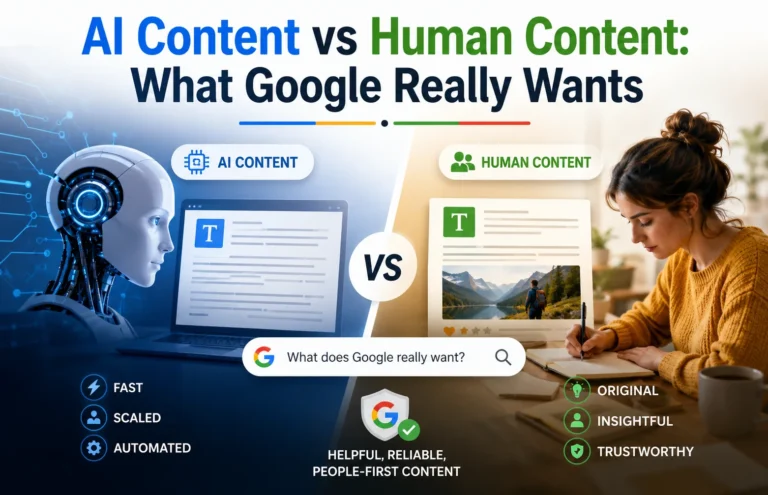
AI Content vs Human Content: Key Differences
| AI Content | Human Content |
| Created quickly | Takes more time |
| Excellent for first drafts | Better storytelling |
| Can summarize information | Shares real experience |
| Consistent formatting | Natural writing style |
| May repeat common information | Adds unique insights |
| Requires fact-checking | Better context and judgment |
Neither approach is automatically better.
The strongest content usually combines AI efficiency with human expertise.
What Google Really Wants
Instead of asking whether AI or humans created the content, Google asks questions like:
- Does this content answer the user’s question?
- Is the information accurate?
- Is it trustworthy?
- Does it offer something original?
- Would someone find it genuinely useful?
If the answer is yes, your content has a much better chance of ranking.
Why Human Expertise Still Matters
AI can collect information quickly, but it cannot replace real-world experience.
For example:
- A doctor explaining patient care
- A fitness coach sharing training advice
- A digital marketer discussing campaign results
- A furniture expert recommending sofa materials
These personal insights make content more valuable because they provide information that AI alone cannot generate from experience.
Adding expert opinions, case studies, practical examples, and original research helps build credibility.
Common Problems With Pure AI Content
Publishing AI-generated content without editing often leads to several issues:
- Generic Information
Many AI articles repeat what already exists online without adding new value.
- Factual Errors
AI can occasionally generate incorrect or outdated information, making fact-checking essential.
- Weak User Experience
Long paragraphs, repetitive ideas, and unnatural wording reduce readability.
- Lack of Originality
Content that simply rewrites existing information rarely stands out in competitive search results.
How to Create Google-Friendly AI Content
If you’re using AI, follow these best practices.
Start With AI
Use AI for:
- Topic research
- Blog outlines
- FAQ ideas
- First drafts
- Content organization
This saves time while improving productivity.
Add Human Expertise
Review every draft and include:
- Personal insights
- Industry knowledge
- Real examples
- Updated statistics
- Practical tips
- Brand experience
These additions make your content unique.
Focus on Search Intent
Every article should answer the user’s actual question.
Before writing, ask:
- What problem is the reader trying to solve?
- What information do they expect?
- What action should they take afterward?
Meeting search intent is more important than adding extra keywords.
Keep Content Simple
Google values content that people can easily understand.
Use:
- Short sentences
- Clear headings
- Bullet points
- Everyday language
- Logical structure
Simple writing improves both readability and user engagement.
Demonstrate Trust
Build credibility by:
- Citing reliable sources
- Updating outdated information
- Including author expertise
- Avoiding exaggerated claims
- Providing balanced recommendations
Trust is becoming even more important as AI-generated content becomes more common.
AI + Human Collaboration Is the Future
The best-performing websites rarely rely on AI alone.
Instead, they use AI to improve efficiency while humans refine the content.
A practical workflow looks like this:
- Research the topic.
- Generate a draft with AI.
- Verify every fact.
- Add original insights and examples.
- Improve readability.
- Optimize headings, FAQs, and internal links.
- Review before publishing.
This approach creates content that is both efficient and genuinely valuable.
Final Thoughts
The debate isn’t really AI content vs human content anymore.
It’s about creating content that genuinely helps people.
AI can make content production faster, but human expertise adds the originality, credibility, and practical knowledge that readers trust. When both work together, the result is stronger content that aligns with Google’s expectations and delivers a better user experience.
At Vivid Digisolution, we believe the future of SEO lies in combining smart AI tools with experienced content strategy. By focusing on people-first, trustworthy, and high-quality content, businesses can build long-term search visibility while staying prepared for the evolving world of AI-powered search.
Frequently Asked Questions
Is AI-written content bad for SEO?
No. AI-written content is acceptable as long as it is accurate, helpful, and created for users rather than search engines.
Can AI content rank on Google?
Yes. Many AI-assisted articles rank well when they provide original value, satisfy user intent, and demonstrate trustworthiness.
Should I rewrite AI-generated content?
Yes. Editing AI drafts improves accuracy, readability, originality, and overall content quality.
Does Google know if content was written by AI?
Google focuses on the quality of the content instead of trying to rank pages based on whether AI was involved in writing.
Which is better: AI or human content?
The best results usually come from combining AI for efficiency with human expertise for accuracy, experience, and originality.