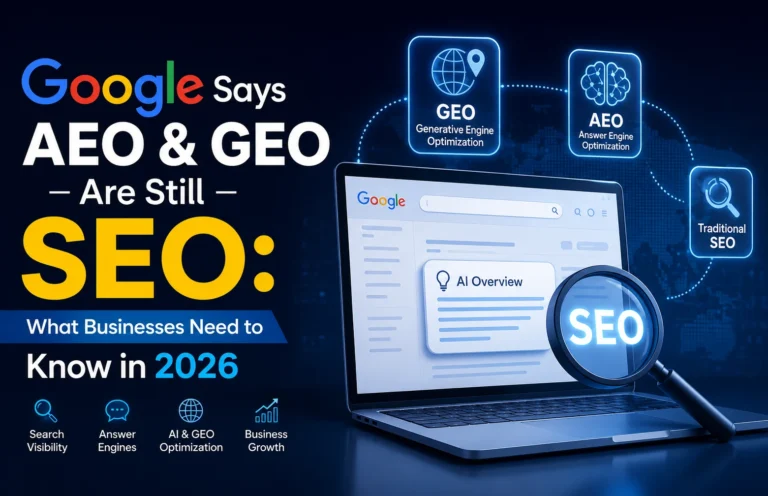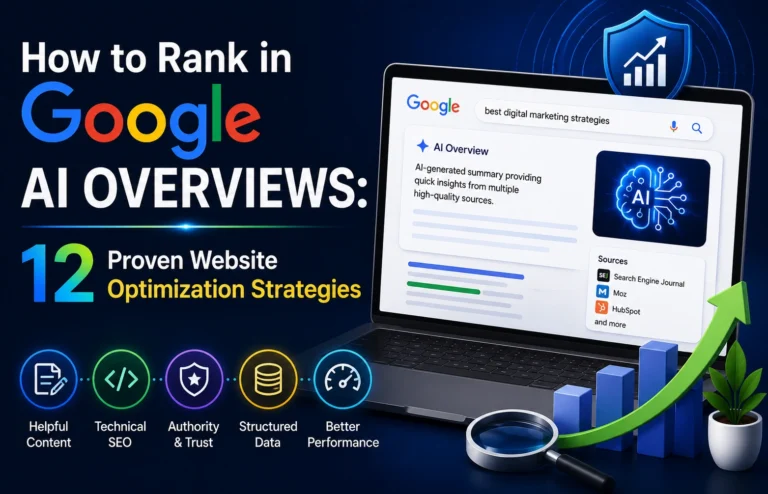
Google has made it clear that Answer Engine Optimization (AEO) and Generative Engine Optimization (GEO) are not replacing SEO. They are simply an extension of modern SEO. Businesses that create helpful, trustworthy, and well-structured content are more likely to appear in Google Search, AI Overviews, ChatGPT, Gemini, and other AI-powered search experiences.
Key Takeaways
- AEO and GEO are extensions of SEO, not replacements.
- Helpful, trustworthy content remains the foundation of search success.
- AEO helps brands answer user questions directly.
- GEO improves visibility in AI-generated search results.
- Strong SEO, E-E-A-T, and structured content help businesses rank across Google and AI platforms.
Introduction
Over the last year, terms like AEO & GEO have become popular. Many businesses believe they need a completely new strategy to rank in AI search results.
However, Google has a different message.
According to Google’s latest AI search guidance, the fundamentals of SEO still matter. Whether your content appears in traditional search results or AI-generated answers, the same principles apply—create useful content, build trust, improve user experience, and make your website easy for search engines to understand.
For businesses, this is good news. You don’t need to abandon SEO. Instead, you need to evolve it.
Why Google Says AEO & GEO Are Still SEO
Google recently explained that optimizing for AI search doesn’t require a completely different approach.
Instead of chasing new buzzwords, businesses should continue following SEO best practices.
That means focusing on:
- Helpful content
- User experience
- Website performance
- Technical SEO
- Authority and trust
- Structured information
AI search systems still rely on high-quality web content to generate accurate answers.
If your website already follows SEO best practices, you’re already building a strong foundation for AEO and GEO.
What Is the Difference Between SEO, AEO, and GEO?
| Feature | Traditional SEO | AEO (Answer Engine Optimization) | GEO (Generative Engine Optimization) |
| Main Goal | Improve website rankings on search engines | Get direct answers featured in search results and AI responses | Increase visibility in AI-generated answers |
| Focus | Keywords, backlinks, technical SEO, rankings | User questions and clear answers | AI understanding, authority, and content relevance |
| Search Platforms | Google Search, Bing, Yahoo | Google Featured Snippets, Voice Search, AI Overviews | ChatGPT, Gemini, Perplexity, AI search engines |
| Content Style | Keyword-focused content | Question-and-answer format with direct responses | Detailed, trustworthy, and context-rich content |
| Optimization Method | Improve pages, links, speed, and rankings | Create concise answers, FAQs, structured content | Build expertise, authority, and AI-readable content |
| User Intent | Understand what users search for | Provide the exact answer users need | Help AI systems recommend your brand as a trusted source |
| Key Ranking Signals | Quality content, backlinks, technical SEO, UX | Clear answers, structured data, helpful content | E-E-A-T, brand authority, content depth, citations |
| Example | Ranking for “best SEO agency” | Answering “What does an SEO agency do?” | Being mentioned by AI when users ask “Which SEO agency should I hire?” |
What Is AEO?
Answer Engine Optimization (AEO) focuses on helping your content appear as direct answers in search engines and AI assistants.
Instead of simply ranking on page one, your goal is to become the answer users receive.
Examples include:
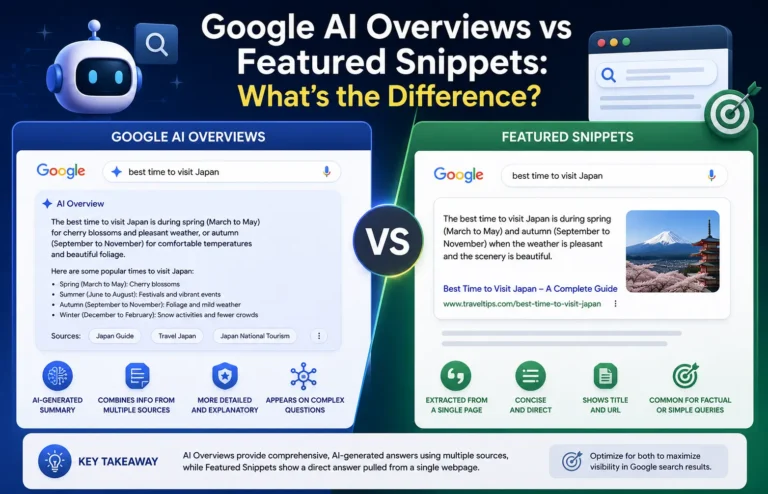
- Google AI Overviews
- Featured Snippets
- ChatGPT responses
- Voice search
- AI assistants
AEO works best when your content clearly answers user questions.
What Is GEO?
Generative Engine Optimization (GEO) means optimizing your content so AI platforms can understand, reference, and recommend it.
This includes platforms such as:
- ChatGPT
- Gemini
- Perplexity
- Claude
- Microsoft Copilot
These platforms look for trustworthy, well-organized, and informative content.
The better your content explains a topic, the more likely AI systems are to reference it.
Why Traditional SEO Still Matters
Some businesses think AI has replaced SEO.
That isn’t true.
AI search still depends on websites that provide accurate information.
Strong SEO helps AI understand:
- What your page is about
- Whether your information is trustworthy
- How relevant your content is
- Whether users find value in your page
Without good SEO, AI search engines have less confidence in your content.
How Businesses Should Optimize for AI Search in 2026
1. Focus on Helpful Content
Write content that genuinely solves user problems.
Avoid keyword stuffing or writing only for search engines.
Every article should answer real questions.
2. Build Topical Authority
Instead of publishing random blogs, create content clusters around your expertise.
For example, a digital marketing agency should cover topics like:
- SEO
- Local SEO
- AI SEO
- Google AI Overviews
- Technical SEO
- Content Marketing
This helps search engines understand your expertise.
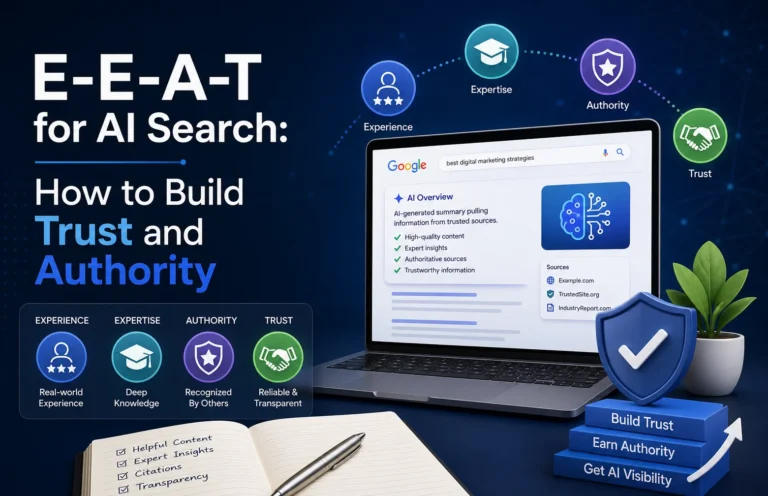
3. Improve E-E-A-T
Google continues to value:
- Experience
- Expertise
- Authoritativeness
- Trustworthiness
Include:
- Author information
- Real examples
- Original insights
- Updated content
- Reliable sources
Trust matters even more in AI-generated search.
4. Answer Questions Clearly
AI systems prefer content with direct answers.
A good format is:
- Question
- Short answer
- Detailed explanation
This improves visibility in AI-generated responses.
5. Use Proper Headings
Organize your content using:
- H1
- H2
- H3
Clear headings help both users and AI understand your page structure.
6. Add Structured Data
Schema markup helps search engines understand your content.
Useful schema types include:
- FAQ
- Article
- Organization
- Local Business
- Breadcrumb
Structured data improves content understanding, even if it doesn’t guarantee AI visibility.
7. Improve Website Experience
Google still values websites that are:
- Fast
- Mobile-friendly
- Secure
- Easy to navigate
A positive user experience benefits both SEO and AI search.
8. Keep Content Fresh
Update older pages with:
- New statistics
- Latest trends
- Current examples
- Better visuals
- New FAQs
Fresh content is more likely to stay relevant.
Common Mistakes Businesses Should Avoid
Many businesses make these mistakes while trying to optimize for AI:
- Ignoring basic SEO
- Publishing AI-generated content without editing
- Chasing AI trends instead of user needs
- Writing only for keywords
- Forgetting technical SEO
- Not building authority
- Using outdated information
Remember, AI rewards quality—not shortcuts.
The Future of SEO Is AI-Friendly SEO
SEO is no longer just about rankings.
It’s about becoming a trusted source of information wherever people search.
Whether users search on:
- ChatGPT
- Gemini
- Perplexity
- Voice assistants
Your content should provide clear, reliable, and valuable answers.
Businesses that combine SEO with AEO and GEO will have a stronger online presence in the years ahead.
How Can Businesses Prepare for AI Search in 2026?
Businesses should focus on creating helpful content, answering user questions clearly, improving website experience, using structured data, and building topical authority. These SEO best practices also help improve visibility in AI-powered search results.
- Create content that answers real user questions.
- Organize content with clear headings and short paragraphs.
- Use schema markup like FAQ and Article schema.
- Keep your website fast, mobile-friendly, and secure.
- Regularly update content to keep it accurate and relevant.
Final Thoughts
Google’s latest guidance sends a simple message: AEO and GEO are not replacing SEO—they are building on it.
Businesses don’t need to start over. They need to improve what already works.
Focus on creating helpful content, demonstrating expertise, improving technical SEO, and delivering a great user experience. These fundamentals remain the key to success across both traditional search engines and AI-powered platforms.
At Vivid Digisolution, we help businesses build future-ready SEO strategies that improve visibility in Google Search, AI Overviews, ChatGPT, and other AI search experiences. By combining proven SEO with modern AI optimization, your business can stay competitive in 2026 and beyond.
Frequently Asked Questions
Is AEO different from SEO?
AEO focuses on optimizing content to answer user questions directly in AI search and answer engines, while SEO improves overall visibility in search results. AEO is considered part of modern SEO.
What is GEO in SEO?
Generative Engine Optimization (GEO) helps AI platforms understand, reference, and recommend your content in AI-generated responses.
Does Google recommend AEO?
Google hasn’t introduced AEO as a separate ranking system. Instead, it recommends following strong SEO practices that naturally support AI search visibility.
How can businesses prepare for AI search?
Create helpful content, improve website speed, build topical authority, use structured data, and maintain strong E-E-A-T signals.
Is traditional SEO still important in 2026?
Yes. Google has confirmed that traditional SEO remains the foundation for visibility in both standard search results and AI-powered search experiences.